




Reggio Emilia, July 14, 2026 – “We are facing a criminal organization of unusual nationality, which did not import for retail sale in the territory but to expand trade directly on a national and international scale.” With these words, the prosecutor of Reggio, Calogero Gaetano Paci, identifies the two distinctive traits of the group of Dominican origin stopped by the carabinieri. A novelty, if we can call it that, for the standards of our province.
Arrests and precautionary measures
Eight arrests in total and six precautionary measures issued by judge Andrea Rat, against two women (between 24 and 45 years old, under house arrest) and six men (between 30 and 37 years old, in custody); all six are investigated for various charges, for trafficking and possession of large quantities of cocaine with the aggravating factor of transnationality. This is a pure cocaine trafficking (80%), dismantled by the investigative activity of the carabinieri of the operational section of the Nor of Reggio, coordinated by the Prosecutor’s Office.
Cocaine from Spain, base in Reggio Emilia
According to investigators, the group had a logistical base in Reggio and had Spain as its main source of supply. The cocaine was transported to Italy with modified cars, equipped with sophisticated double bottoms or electronic mechanisms designed to use the rear bumper as a ‘safe’.
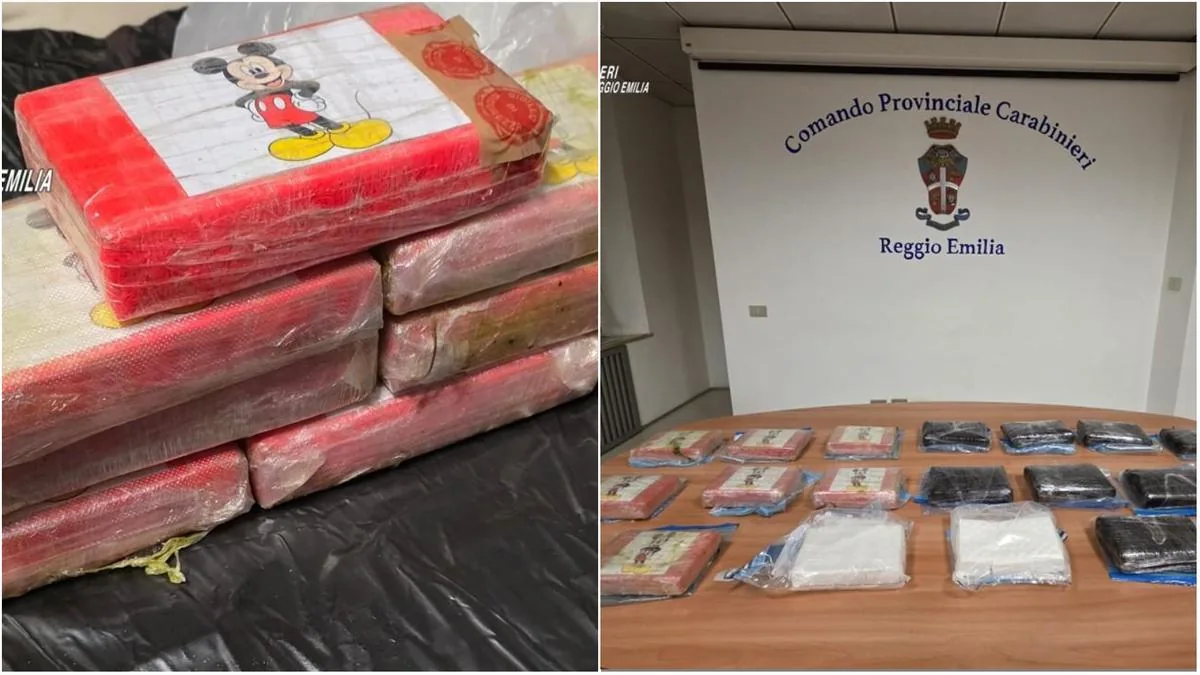
Bricks marked ‘Topolino’
The bricks were wrapped in materials and chemical substances specifically to avoid being detected by drug-sniffing dogs. Each was marked with the decal ‘Mikey Mouse’ (Topolino, ed.), a real brand that denotes “the level of reliability of the group on the market,” adds Paci.
The cars used the relay technique to evade controls (a ‘clean’ vehicle preceding the one loaded with drugs). Many trips involved women and in several cases also minor children, to disguise the trafficking as a family outing and appear less suspicious.
Trafficking of 43.5 kg of cocaine
The investigation, supported by wiretaps and GPS tracking, documented trafficking of 43.5 kilograms of cocaine, of which 21.5 were seized and 22 monitored during transfers; a turnover of about 700 thousand euros (considering only the seized quantity) and a potential market value of about 3 million, considering the purity of the substance. The network supplied Emilia-Romagna, Lombardy, Liguria, Tuscany, Friuli Venezia Giulia, Lazio, Umbria, and Piedmont.