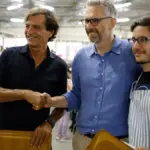


Bologna – Francesco under the stage lights with his guitar slung over his shoulder and a flask of wine beside him; Francesco at Vito, the singer-songwriters’ restaurant near via Paolo Fabbri 43, playing tarocchino between Lucio Dalla and Jimmy Villotti in that Bologna where you could eat for a thousand lire, whisky included; Francesco in the boisterous cheerfulness of the Osteria delle Dame ready to scold his friend Bonvi, the father of the Sturmtruppen, who loudly asks him for ‘La locomotiva’ shouting ‘choo choo’. But also Francesco, far from any clamor with his wife Raffaella in the reassuring quiet of Pavana and an Appennine now uninhabited; Francesco, a highly sought-after writer even running in the final five of a Campiello; Francesco ready to claim his intellectual work to the last in open controversy with Jovanotti.
Read more Guccini, the pain of Pavana’s friends: “We used to roam down these hills to gather chestnuts and to
Now that he, the Maestrone, is gone, the contours of this authentic icon capable of spanning two centuries, capturing the attention of different generations, betting on straightforwardness, coherence, and courage, take on even greater strength. Through the power of poetry.
When asked if he ever thought about death, Guccini replied that it was not yet the time and that he would reflect on it later. “I try to stay attached to the ‘fiopa’ that is the poplar, the tree of life – he repeated quoting a dialect proverb – So far, at least, I have arrived here and done something.”

The albums that entered music history
And what he did… Albums that entered history (‘Folk beat n.1’ is from ’67, ‘Canzoni da osteria’ from ’23), songs that accompanied the trajectory of a country (from ‘Dio è morto’ to ‘Eskimo’, from ‘Culodritto’ dedicated to his daughter Teresa to ‘L’avvelenata’, the piece he liked the least), unforgettable events like the concert on June 14, 1984, in Bologna with 150,000 people packed in Piazza Maggiore to listen to ‘Tra la via Emilia e il West’. “For me – he later explained – it was the Emilian countryside that represented our Far West.” Because, as is known, it is the small stories that build History.
Born in Modena on June 14, 1940, raised “among the ignorant mountain sages who knew Dante by heart”
Guccini was born in Modena on June 14, 1940, but grew up, due to the war, ‘among the ignorant mountain sages who knew Dante by heart and improvised poetry’ precisely in Pavana. A place to which he would dedicate his first novel ‘Croniche epafaniche’ published in 1989. In Modena (the ‘Little city’ of the song) his youth was spent: there he worked for two years as a journalist at the Gazzetta dell’Emilia and decided to devote himself amateurishly to music, also playing in dance halls. “I bought my first guitar – he recalled – for five thousand lire from a carpenter in Porretta.” And he talked about all this in his last book ‘Così eravamo’.
“When Equipe 84 was born they asked me to join. I would have liked to for the money and the girls but I said no”
The Guccini family moved to Bologna in ’61 and Francesco enrolled at university where he would never graduate (however, he received an honorary degree in 2002). Music was waiting for him. He explained: “When Equipe 84 was born they asked me to join. I would have liked to for the money and the girls but I said no. When my first song ‘Auschwitz’ ended up on a record I didn’t see a penny because I wasn’t registered with SIAE.” From that period is ‘Canzone per un’amica’, the song that opened all his concerts until the last one on December 5, 2011, in Casalecchio where he fell ill (the closing of the live shows was always reserved for ‘La locomotiva’).
“We were all young and the girls all beautiful. Bologna was different”
With the breakthrough album ‘Radici’, the most fortunate period began in the early ’70s: the LPs ‘Via Paolo Fabbri 43’ and ‘Amerigo’ arrived, it was the time of the osterias and endless nights, there were friends and endless card games. “We were all young – he would say – and the girls all beautiful. Bologna was different.” The rest, between reprints and new releases, is recent history and reaches last year’s version of ‘Bella ciao’. His songs are made of political and civil commitment, tell fragile loves, and show high quotations and linguistic games.

Bestsellers, comics, and actor in cinema
After all, the Maestrone has always worked around the word, its origins, and its possible elaborations. This is well demonstrated by his literary activity, starting from bestsellers like ‘Vacca d’un cane’ and ‘Cittanova blues’. Fundamental was the collaboration with Loriano Macchiavelli from which some of the most successful crime novels of recent years were born, from ‘Volagolondrina’ to ‘Tempo di Elfi’. Curiosity also led him to try his hand in other fields, from comics to cinema where he acted in various films. In ‘Radiofreccia’, the first film directed by Luciano Ligabue, he played a bartender who reminded of the legendary Mario from ‘Certe notti’.
The last times in Pavana
In recent times in Pavana he spent his days, despite vision problems, writing and reading. Sometimes he had to get up from his desk because some group of young people knocked on the door to greet him. And there was always a glass of wine for everyone.
