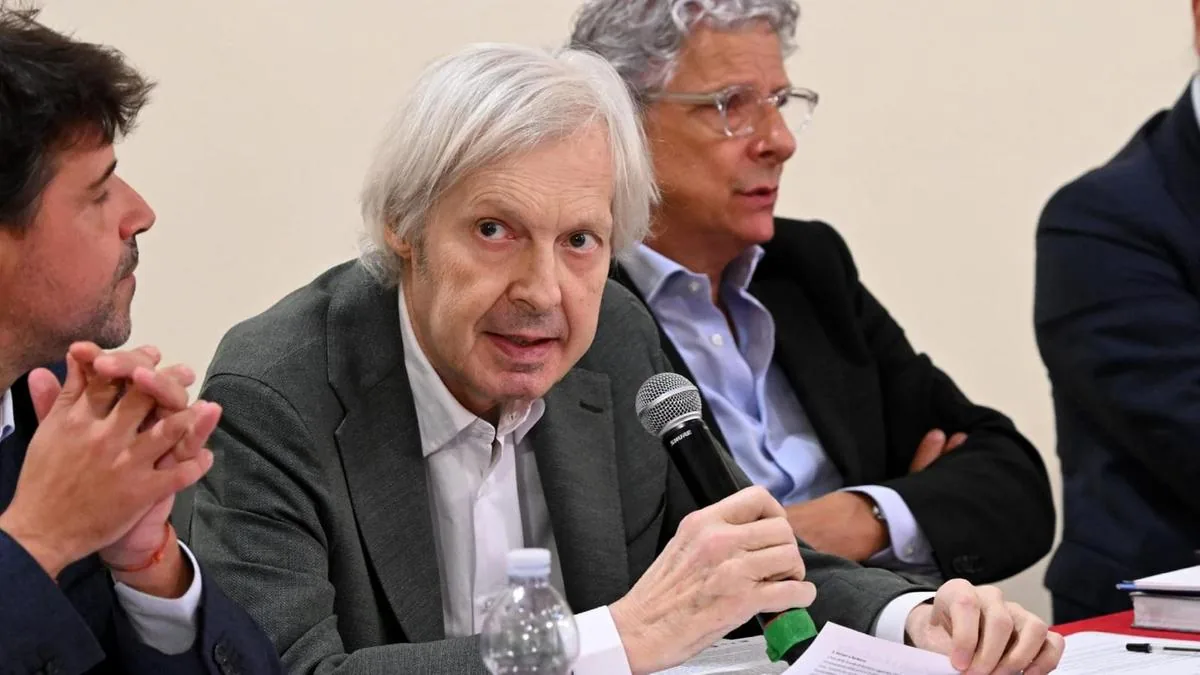








Bologna, August 28, 2026 – A draft that saves from oblivion stories from a distant time, the cry of a girl passing by on a bicycle, a very hot summer day. These ingredients are enough for a bright and dreamy story to flow from the pen of Francesco Guccini, like certain memories of youth. It is titled ’Calde le pere. Story of a river and an incorruptible maiden’ and is the posthumous novel of Francesco Guccini published by Giunti Editore.
A bit risqué, Boccaccian, in the purest tradition of Italian storytelling, and a bit, on the contrary, almost light, sepia-toned by the patina of tenderness and nostalgia left by the past time, this story is rich in echoes, because, going back to an even more remote past, it even evokes the pagan myths of classical tradition. It almost seems written by a bolder Virgil or a more modest Ovid. The reader will enjoy reading this mischievous little picture full of old-time sensuality at least as much as Guccini enjoyed recovering this little gem from the waters of the Italian Reno. “But why warm? One can imagine them soft, tender, caressing, at most lukewarm, but not warm. We must then try another explanation.”
The last statement of Francesco Guccini
“’Calde le pere’ was born from a draft that a friend of mine told me about, who also made a cabaret show from it. The two stories he told me, that of the girl on the bicycle and that of the chaste maiden who becomes pregnant while bathing in the Reno, fascinated me greatly. Casalecchio sul Reno was then the Lido of Bologna, with over ten thousand visitors a day in summer, so much so that from the 1930s to the 1950s postcards were printed showing the weir on the Reno that had created a large bathing basin.
The book starts as Vola Golondrina, the last mystery I wrote with Loriano Macchiavelli, started: there was the passage of a mysterious motorcyclist distributing flyers; here instead there is a girl on a bicycle, evidently a prostitute – a mirror figure to that of the madam who at the end of this book plays the role of a gynecologist ante litteram. I have always loved the narrative springing from a triggering event, or the irruption of a deus ex machina, almost a theatrical coup. As in several other of my novels, I then divided the book into scenes, giving them a title and an ironic caption as some of my most beloved authors would have done, from Sterne to Jerome.”
“In the story there is also a tribute to Pavana, when I abandon myself to the poetic imagination of the breeze that blows from the source of the Reno on the Pistoia Apennines through woods and meadows: there I wanted to name herbs, flowers, and fruits with the same Pavana terms found in the Epaphanic Chronicles and in Tralummescuro, because words are important and their sound is what we have learned to love things with.
It is important for me to preserve the words of the dialect, to save all those names. The Reno, then, is the river of my life, which I have made the protagonist of many of my songs, but which in reality, like Claudio Magris’s Danube, is born from the dripping of a tap on the Apennines. In these pages I also wanted to recall its epic events, to ask myself if there ever was a ’navy’ of the Reno… If I think about it, it is the other axis that crosses that of the Via Emilia: perhaps, lying in that river, with my head among the meadows of Pavana, my feet towards Modena and Bologna, my arms embracing the woods, there is also me.”

The complete incipit of the Maestrone’s book
“Some time ago a friend of ours, a skilled journalist, actor, TV host, and witty cabaret artist, received, perhaps precisely for the reasons mentioned above, a file that we will henceforth call Draft: a haphazard collection, partially bound in a makeshift way, of typewritten, mimeographed, photocopied sheets accompanied by various interviews, whose main subject was risqué stories that happened in the brothels and surroundings of Bologna of the past. The author of this curious Draft, who is not anonymous because the man introduced himself with name and surname, perhaps wanting to derive from his patient research work either a regular book or some kind of show, has mysteriously disappeared: nothing is known about him anymore, despite numerous, even if not detailed, searches.
Of him, this semi-unknown and passionate compiler, we have left the Draft, a precious albeit disorderly anthology of bordello stories, and a striking title: Calde le pere! “Calde le pere!?” The cryptic title, according to a page of the Draft, was due to a curious episode. We do not know exactly when, but it seems that a prostitute, whom we imagine to be no longer young, circulated, perhaps under the influence of various alcoholic drinks, pedaling a bicycle among “the oblique fury of carts” (as the poet says), disheveled and half-undressed, showing from a short skirt that she wore no underwear of any kind and (feet on the handlebars) thighs no longer with the full roundness of youth, shouting loudly the aforementioned obscure phrase: “Calde le pere!”.

The exclamation, as we anticipated, is difficult to interpret. If we focus on the noun, pere (pears), the first image that comes to mind is that of a popular term referring to the female breast […]. But why warm? One can imagine them soft, tender, caressing, lukewarm, but not warm. We must then try another explanation. In still analog times in which we spent our youth, and not the damn digital ones we live in, industrious little artisan housewives awaited us at school exits, offering us students, tormented by hours of torture from the then fierce teachers, the comfort of modest but tasty products of ingenious autarkic manufacture, such as toothpicks on which slices of apple were soberly (very soberly) covered with caramelized sugar or, in Bologna, mistocchine, that is, sweets made with chestnut flour pressed into special molds, baked in the stove oven. It is that then chestnut flour cost little, and chestnuts were unfortunately the main food of mountain people.
Today the arduous process of chestnut cultivation is almost abandoned, and this makes chestnut flour almost impossible to find, rarer and more expensive than gold. Less greedy than the roasted chestnut sellers were those modest predecessors of street food who also stood in front of our schools and elsewhere. Some of them, of great ingenuity and notable achievement, presented themselves holding small trays on which some specimens of pears towered, sometimes cooked in wine, sometimes in butter and sugar. Their inviting cry was, if we are not mistaken: “Warm, the pears!”.
The mystery remains as to why this no longer young peripatetic woman, performing dangerous cycling virtuosity, felt the need to make the cry of the pear sellers her own. Perhaps the woman’s shout contained a subtle erotic double meaning, an obscene and self-promotional offer. The friend who received the haphazard Draft then pointed out to us, among the many casually assorted events of the, let’s say, collection, a story that has almost nothing to do with brothels except tangentially, except in the single, fleeting, and almost irrelevant appearance at the end. It is an unlikely, absurd, unreal rather than surreal story. We hardly know the protagonists. It is about a modest little family whose members’ names we do not even know, only that of the daughter: Lisa or Lisetta, an ethereal girl, extremely pure, the emblem of chastity and virginity.”
Read more Sets fire to neighbor’s hedge with LPG: «I am exasperated.» 46-year-old woman arrested
(Copyright by Giunti Editore S.p.A).